Real-World Reliability: Testing RV Roof Lift Systems Under Extreme Temperatures
The True Test of an RV Component Isn’t in the Lab—It’s in the Wild.
When we talk about RV automation, we often focus on speed, noise levels, or lift capacity. But for a manufacturer or a seasoned overlander, the real challenge begins where the pavement ends.
Imagine a Truck Camper parked in the sub-zero peaks of the Alps, or a Caravan enduring the scorching 45°C heat of a Texas summer. In these environments, the question isn't just "Does it work?" It’s "Will it fail when the user needs it most?"
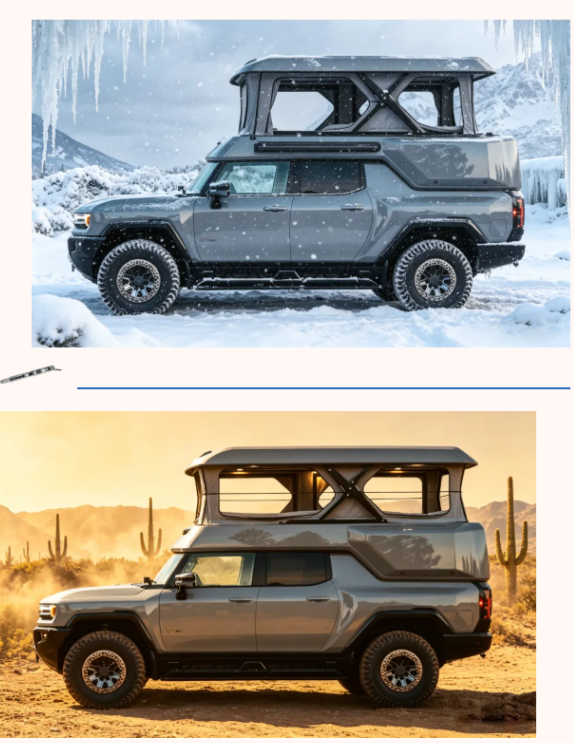
Temperature isn't just a number; it’s a force that changes the physical properties of a lift system.
In Extreme Cold: Lubricants can thicken, seals harden, and motor starting loads spike as internal friction increases. Without the right design, a system might stutter or fail to initiate the lift.
In Extreme Heat: Continuous operation leads to rapid thermal buildup. This can destabilize control electronics and accelerate the aging of composite materials, leading to premature failure.
For an electric roof lift system, these aren't just theoretical risks—they are the leading causes of warranty claims and field dissatisfaction.
To ensure that Cartuator systems don't just "survive" but thrive in these conditions, we subjected our latest RV lift brackets and actuators to rigorous high-and-low temperature environmental testing.
The Test Scope:
Cold-Start Reliability: Verifying immediate response and smooth transit at minimum operating temperatures.
Thermal Endurance: Continuous cycling under high-load and high-heat conditions to monitor stability.
Signal Integrity: Ensuring the control system maintains precise feedback without lag or error, regardless of the ambient temp.
The Conclusion:Our systems maintained consistent performance across the entire thermal spectrum. Whether it was the initial response time or the smoothness of the stroke, the results were clear: the system remains stable, predictable, and safe.
Passing a high-low temperature test isn't a stroke of luck; it’s the result of intentional engineering choices:
Optimized Internal Structure: Reducing friction points to ensure smooth movement even when materials expand or contract.
Motor-Driver Calibration: Advanced algorithms that adjust power output based on environmental resistance.
High-Grade Sealing & Materials: Using specialized polymers and seals (IP67M rated) that remain flexible in the cold and stable in the heat.
Electronic Resilience: Control boards designed with industrial-grade components to prevent signal drifting.
| (No.) | (Environmental Reliability Test) | (Standard Requirements) | (Test Results) | (Verdict) |
| 1 | Low-Temperature Operational Test | Place sample in chamber at -40°C. Perform continuous lift cycles. Log status every 24h. Return to room temp. Sample must function normally. | Sample operated normally for approx. 2150 cycles. Resumed operation smoothly after returning to room temp. | Pass |
| 2 | High-Temperature Operational Test | Place sample in chamber at +75°C. Perform 2000 continuous lift cycles. Log status every 24h. Return to room temp. Sample must function normally. | Sample operated normally throughout the test. | Pass |
For RV manufacturers in competitive markets like North America and Europe, reliability is the ultimate currency. An automated roof lift is a high-frequency, high-dependency component. If it fails, the vehicle is effectively out of commission.
By prioritizing extreme-environment testing, we shift the narrative from "it has these features" to "you can trust this in any season."
In the evolving world of RV automation, parameters on a spec sheet are only half the story. The other half is proven performance in the real world. At Antuator, we don't just build systems that lift; we build systems that last—so your customers can explore further, stay longer, and travel with total peace of mind.